Cognitive Behavioural Therapy (CBT) is a form of psychological therapy developed in the 1960s by Dr Aaron Beck. It is one of the most widely used and well-researched approaches in mental health today, helping people better understand themselves and cope with a wide range of difficulties. CBT can be applied to adults, children, adolescents, couples, and families.
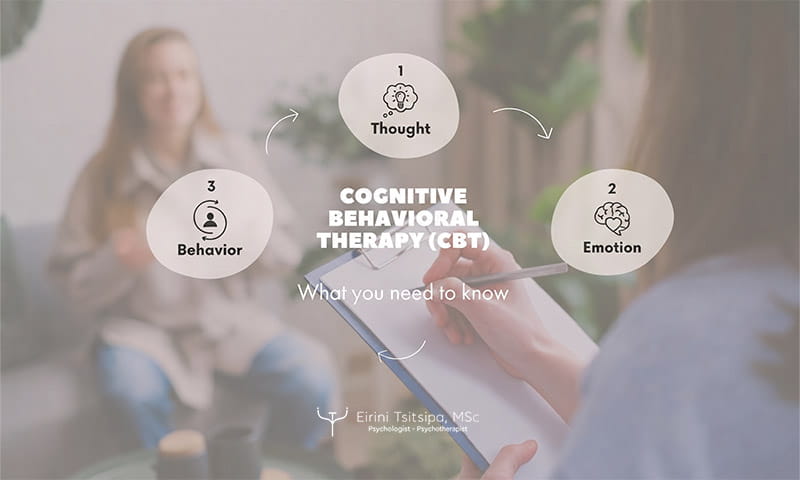
At its core, CBT is based on a simple but powerful idea: the way we think about a situation affects how we feel, and how we feel influences how we respond or behave.
To make this clearer, consider the following example:
Eleni needs to present her work to her colleagues.
In one case, she thinks: “I’m going to forget what I want to say and embarrass myself.”
In another case, she thinks: “Once this is over, I’ll have more time for things I enjoy.”
In the first case, she is more likely to feel anxious and overwhelmed, which may make the presentation more difficult.
In the second, she is more likely to feel calmer and more in control, which can help her manage the situation more effectively.
The thought “I’m going to forget what I want to say” is an example of a cognitive distortion. These are common patterns of thinking that all people experience from time to time. In this case, it involves predicting a negative outcome without considering other, more realistic possibilities. This is often referred to as catastrophising or “jumping to the worst-case scenario.”
CBT helps individuals become more aware of these patterns, question them, and gradually replace them with more balanced and helpful ways of thinking.
The process may also include techniques such as:
- understanding how thoughts, emotions, and behaviours are connected (psychoeducation)
- identifying and recording thoughts
- learning ways to manage difficult emotions
- developing problem-solving skills
- improving communication
- Είναι χρονικά περιορισμένη
- Είναι δομημένη
- strengthening self-confidence and self-esteem
Each therapeutic plan is tailored to the individual, taking into account their unique needs, goals, and pace.
CBT is supported by a strong body of scientific research and has been shown to be effective for a range of difficulties, including depression, anxiety, eating disorders, health anxiety, and obsessive-compulsive disorder. It is recommended by organisations such as the National Institute for Health and Care Excellence (NICE) and the American Psychiatric Association.
Some key features of CBT include a focus on the present moment, a collaborative relationship between therapist and client, and an active role for the individual in the process. It is typically structured, goal-oriented, and time-limited, helping individuals develop practical skills they can continue to use in their everyday life.
CBT can be offered on its own or alongside medication, when this is recommended by a medical doctor.
It is also important to note that a well-trained CBT therapist has completed thorough theoretical and practical training, usually lasting three to four years, and holds appropriate certification. Short seminars or brief courses, while useful, are not sufficient on their own to qualify someone as a CBT therapist.
References:
DiMauro, J., Domingues, J., Fernandez, G., & Tolin, D. F. (2013). Long-term effectiveness of CBT for anxiety disorders in an adult outpatient clinic sample: A follow-up study. Behaviour research and therapy, 51(2), 82-86.
Høifødt, R. S., Strøm, C., Kolstrup, N., Eisemann, M., & Waterloo, K. (2011). Effectiveness of cognitive behavioural therapy in primary health care: a review. Family practice, 28(5), 489-504.
Oud, M., De Winter, L., Vermeulen-Smit, E., Bodden, D., Nauta, M., Stone, L., … & Stikkelbroek, Y. (2019). Effectiveness of CBT for children and adolescents with depression: A systematic review and meta-regression analysis. European psychiatry, 57, 33-45.