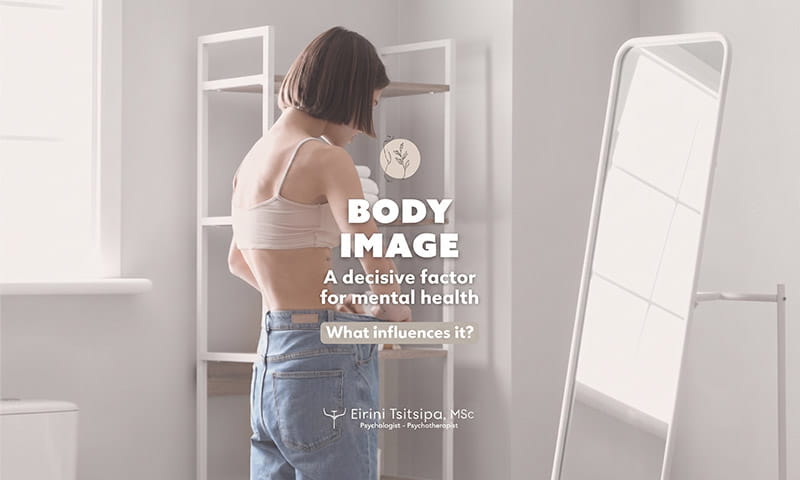
Body image is an important aspect of our personality and a key factor in overall mental well-being. It is not defined only by how we think our body looks, but rather includes three main components: (a) our perceptions of its size (how large or small we believe it to be, regardless of objective measurements), (b) our feelings about our body, and (c) our behaviours, meaning the ways we try to influence or improve our appearance (e.g. restrictive dieting, body care, exercise).
Body dissatisfaction often arises from the discrepancy between the body we have, the way we perceive it, and the body we would ideally like to have. This dissatisfaction is influenced by several factors, some of the most important of which are outlined below.
Sociocultural Factors :
In many Western societies, there is significant social pressure to conform to thin body ideals. Within this context, a “desirable” body is often equated with low body weight, while bodies that differ from this standard may be marginalised or even stigmatised. Research has shown that women of colour tend to report higher body satisfaction compared to white women.
The Role of the Family:
Η στάση της οικογένειας σε θέματα εμφάνισης, τα άμεσα ή έμμεσα αρνητικά σχόλια για την εμφάνιση του παιδιού (ή ακόμη και τα σχόλια για την εμφάνιση άλλων), και η κριτική των γονέων, φαίνεται να επηρεάζουν τον τρόπο που το παιδί θα νιώσει για το σώμα του. Με τέτοιου είδους σχόλια, το παιδί λαμβάνει το μήνυμα ότι απογοητεύει γονείς του και προσπαθεί να «ελέγξει» το σώμα του με δίαιτες, υπεργύμναση κτλ. Μελέτες έχουν δείξει πως η υπερβολική ενασχόληση των ίδιων των γονέων με τη δική τους εμφάνιση, με το βάρος τους, και με την υπερβολικά «υγιεινή» διατροφή, αυξάνει την πιθανότητα το παιδί τους να εμφανίσει δυσαρέσκεια με το σώμα του και να αναπτύξει κάποιας μορφής Διαταραχής Πρόσληψης Τροφής (Νευρική Ανορεξία, Νευρική Βουλιμία, Διαταραχή Υπερφαγίας) στην εφηβεία του. Η ασφάλεια στη σχέση ενός ατόμου με τους γονείς του προάγει θετική εικόνα για τον εαυτό και έτσι εκδηλώνεται λιγότερη δυσαρέσκεια για το σώμα στην ενήλικη ζωή.
The Role of Peers:
Peers also play a crucial role. Acceptance or rejection by one’s social group, as well as the beliefs that group holds about what is considered attractive or acceptable, can significantly influence how individuals feel about their bodies.
Social Media :
Research has shown that time spent on social media, as well as engagement in photo editing and the use of filters, is associated with increased body dissatisfaction. Social media platforms can strongly influence how we evaluate our bodies and how we internalise societal standards of beauty. For example, frequent use of platforms such as Facebook has been linked to lower self-esteem and increased social comparison.
Self-Esteem:
High self-esteem appears to act as a protective factor against negative comments about appearance. Conversely, low self-esteem is associated with greater vulnerability to body image concerns.
Objectification of the Bod :
Objectification refers to viewing and evaluating one’s body from an external perspective, focusing primarily on observable characteristics. In this way, the body is experienced as an object to be looked at and judged, rather than as a lived, internal experience.
This can lead individuals to constantly monitor their appearance, engage in frequent mirror-checking, and experience shame about their body, or even about themselves as a whole. It may also foster the belief that, with enough effort, body shape, size, and weight can be fully controlled. As a result, individuals may begin to treat their body as something that must be shaped to fit societal standards.
Consequences of Body Dissatisfaction
Body dissatisfaction has been linked to behaviours such as restrictive dieting, misuse of laxatives, excessive exercise, and the use of anabolic substances. It is also a significant risk factor for the development of eating disorders and represents a core feature of these conditions.
More broadly, dissatisfaction with body image can range from mild feelings of unattractiveness to intense preoccupation with appearance, which may significantly interfere with daily functioning (e.g. avoiding school or work due to distress).
How Can It Be Addressed?
One effective approach to addressing body dissatisfaction and the associated emotional distress is Cognitive Behavioural Therapy (CBT).
CBT focuses on identifying and modifying unhelpful thoughts and behaviours that contribute to psychological difficulties. In the context of body image, it helps individuals recognise and challenge negative beliefs about their body and develop healthier behavioural patterns.
Through this process, the therapist works collaboratively with the individual to replace unhelpful thinking patterns with more balanced and realistic perspectives. CBT also includes techniques for managing anxiety and depression, which often accompany body image concerns.
References
Dakanalis, A., Clerici, M., Bartoli, F., Caslini, M., Crocamo, C., Riva, G., & Carrà, G. (2017). Risk and maintenance factors for young women’s DSM-5 eating disorders. Archives of Women’s Mental Health, 20, 721–731.
Davison, T. E., & McCabe, M. P. (2006). Adolescent body image and psychosocial functioning. The Journal of Social Psychology, 146(1), 15–30.
Hawi, N. S., & Samaha, M. (2017). The relations among social media addiction, self-esteem, and life satisfaction in university students. Social Science Computer Review, 35(5), 576–586.
Jones, A. M., & Buckingham, J. T. (2005). Self-esteem as a moderator of the effect of social comparison on women’s body image. Journal of Social and Clinical Psychology, 24(8), 1164–1187.
Pfund, G. N., Hill, P. L., & Harriger, J. (2020). Video chatting and appearance satisfaction during COVID-19: Appearance comparisons and self-objectification as moderators. International Journal of Eating Disorders, 53(12), 2038–2043.
Schaefer, L. M., Burke, N. L., Calogero, R. M., Menzel, J. E., Krawczyk, R., & Thompson, J. K. (2018). Self-objectification, body shame, and disordered eating: Testing a core mediational model of objectification theory among White, Black, and Hispanic women. Body Image, 24, 5–12.
Turner, H. M., Rose, K. S., & Cooper, M. J. (2005). Parental bonding and eating disorder symptoms in adolescents: The mediating role of core beliefs. Eating Behaviors, 6(2), 113–118.
Vogel, E. A., Rose, J. P., Roberts, L. R., & Eckles, K. (2014). Social comparison, social media, and self-esteem. Psychology of Popular Media Culture, 3(4), 206–222.
Χάιντς, E. (2020). Εικόνα Σώματος και Διατροφικές Διαταραχές. University Studio Press.